The Meaning of the Great Seal of The United States
What is the Great Seal?
The Great Seal of the United States is the official emblem and heraldic device of the United States of America. It was adopted by the Continental Congress on June 20, 1782, to represent the nation and to demonstrate to other nations of the world the ideas and values of its Founders and people. Great Seals have their origins in the royal seals of the 7th, 8th, and 9th centuries.
The Great Seal is used to authenticate important official U. S. documents such as treaties, presidential proclamations, appointments of government officials, congressional resolutions, executive orders, and presidential communications to heads of foreign nations. It is even featured on some currency notes and coins including the U. S. $1 bill, proving U. S. citizens with a ready reference to the nation’s foundational ideas. It is used 2,000-3,000 times per year to seal documents. The custody of the Great Seal is assigned to the U.S. Department of State. The seal can be affixed by an officer of the Secretary of State.
The Great Seal was first used officially on September 16, 1782, to guarantee the authenticity of a document that granted full power to General George Washington “to negotiate and sign with the British an agreement for the exchange, subsistence, and better treatment of prisoners of war.” Thomas Jefferson was the first Secretary of State to have custody of the Great Seal.
What Does The Great Seal Represent?
“Symbolically, the Seal reflects the beliefs and values that the Founding Fathers attached to the new nation and wished to pass on to their descendants.”
– U.S. Department of State, Bureau of Public Affairs
The Great Seal Design
The Great Seal has two sides and displays several important symbols. The front (obverse) side of the seal shows the coat of arms of the United States. The U.S. coat of arms is officially used for coins, postage stamps, stationary, publications, flags, military uniforms, public monuments, public buildings, embassies and consulates, passports, and items owned by the U.S. government.
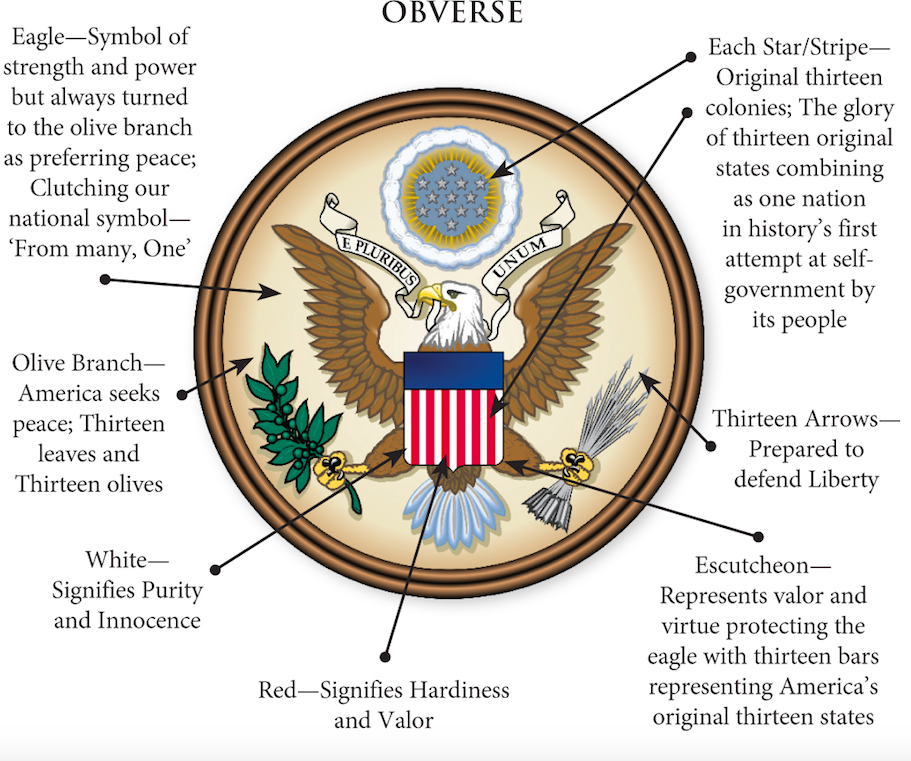
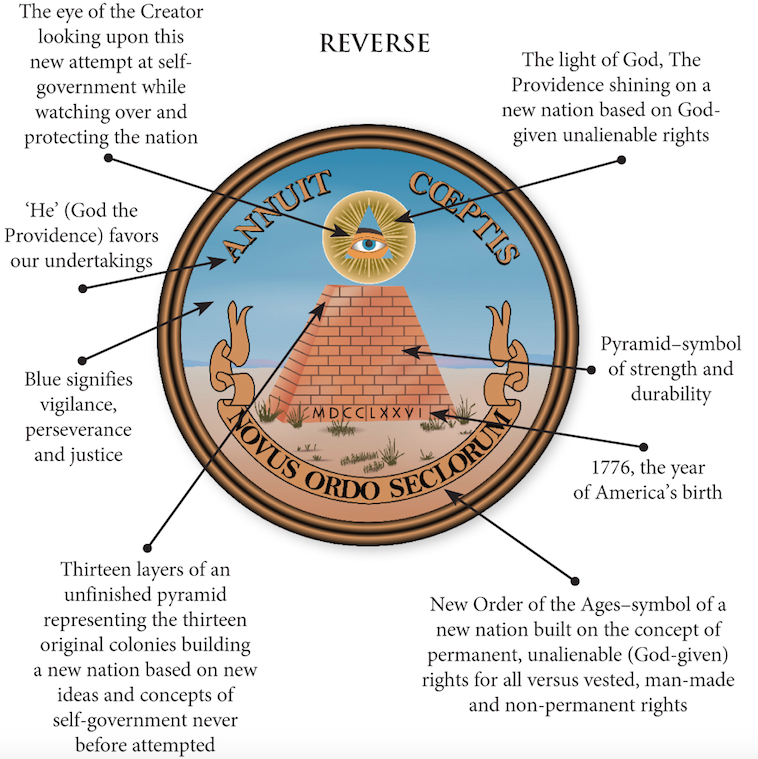
Learn More from the American Heritage Education Foundation
The American Heritage Education Foundation (AHEF) provides free K-College educational resources for teachers, students, and citizens. Do you know the meaning behind The Great Seal? Our Great Seal document breaks it down for you.
Visit The Founding Blog for more valuable insights or contact us directly to learn about our organization.
Check out Elementary School lesson plans for The Great Seal in America’s Heritage: An Adventure in Liberty.
This unit is available to download from the Member Resources at www.americanheritage.org.
Related posts:
1. Three P’s That Led to Freedom in the West: Protestant Reformation, Printing Press, and Pilgrims
2. The Puritans’ Moral Authority Was the Bible
3. Why and How Did Schools Begin in the United States: The Puritans Supported Education for Bible Literacy
4. How the Great Awakening Effected Church and Society: Education, Missions, Humanitarianism, Women, & the Gospel
5. The Bible Was the Most Cited Source of the American Founding Era
6. The American Quest for Self-Government
7. Bible Education and the Northwest Ordinance of 1787
8. The Coming Crisis of Citizenship: Higher Education’s Failure to Teach America’s History and Institutions
9. Civic Knowledge: Americans’ Increasing Ignorance of American Principles, History & Government Can No Longer Be Ignored
10. The Need and Legal Right to Teach Religious History in Public Schools
11. American History & Western Civilization Challenge Bowl (AHWCCB)
12. Freedom: The First Most Important Characteristic of America
13. Unity: The Second Most Important Characteristic of America
14. Progress: The Third Most Important Characteristic of America
15. Responsibility: The Fourth Most Important Characteristic of America
16. The Meaning of the Great Seal of the United States
Copyright © American Heritage Education Foundation. All rights reserved.
Published by: The Founding