The Puritans’ Moral Authority was the Bible
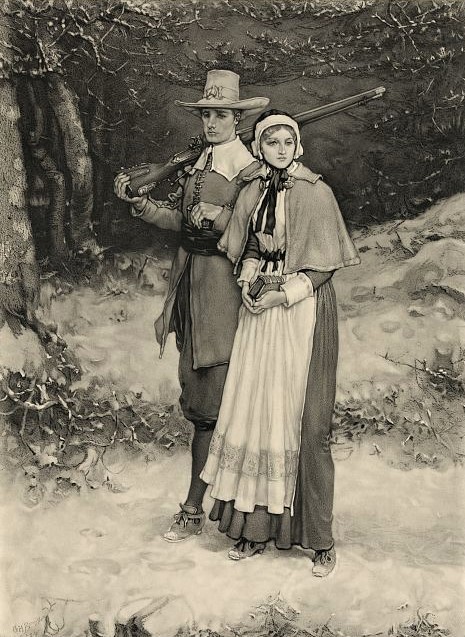
Puritans Going to Church by George Henry Boughton, c1884
The Puritans of early Massachusetts and Connecticut believed that the Bible was God’s divinely-inspired written Word, and this sacred book was the foundation of the Puritans’ morality and colonies. The Bible contains the moral law of God as expressed in the Ten Commandments, the Two Great Commandments, and other teachings of Moses, the prophets, Jesus Christ, and the Apostles. Other ceremonial laws were practiced by the Israelites of the Bible in their Jewish nation, but those laws were not considered part of God’s moral law, nor applicable to other peoples.
In Exodus 20:1-17, God gives Moses and the ancient Israelites the Ten Commandments to follow. He commands that they have no other gods, make no idols, do not take His name in vain, keep the Sabbath rest, honor father and mother, do not murder, do not commit adultery, do not steal, do not bear false witness against neighbor, and do not covet your neighbor. The greater spirit of these laws is summarized in the Two Great Commandments—to love God and to love others—also known as the “Law of Love” found in Deuteronomy 6:5, Leviticus 19:18, and Matthew 22:37-40. In Matthew, when Jesus is questioned by a religious leader about the greatest commandment of the law, Jesus replies with the two commandments of love: “‘‘You shall love the Lord your God with all your heart, with all your soul, and with all your mind.’ This is the first and great commandment. And the second is like it: ‘You shall love your neighbor as yourself.’ On these two commandments hang all the Law and the Prophets.’”
The Puritans sought to uphold this Biblical morality in their communities. They aimed to create colonies that were centered on the Bible.
From AHEF and Angela E. Kamrath.
—–
Activity: Miracle of America High School Teacher Course Guide, Unit 3, Part 2 of 3, Activity 3: Learning More About the Puritans, p. 118, 317-319. MS-HS.
Related Posts:
1. A City on a Hill: Why John Winthrop and the Puritans Came to America
2. The Puritans in America Identified with the Ancient Israelites and Practiced Covenants
3. Why the Puritans Favored Limited Government
4. The Puritans in America Favored Rule of Law Based on the Bible
5. The Puritans in America Created the First Written Constitution of Law
6. The Puritans in America Elected Representatives to Govern in their Colonies
7. Why Puritan Thomas Hooker Favored Democracy Over Aristocracy
8. Challenges in the Early Puritan Colonies: The Dilemma of Religious Laws and Dissent
9. Why and How Schools Began in the United States: The Puritans Supported Education for Bible Literacy
Learning More About the Puritans
Purpose/Objective: Students learn about how the Puritans’ religious beliefs affected their political views and about the Bible-based governing principles/values that characterized their colonies including self-government, limited government, moral truth, rule of law, constitutions, popular sovereignty, elected representatives, work ethic, and literacy.
Suggested Reading: Chapter 3 of Miracle of America sourcebook/text. Students read sections Introduction to 3.13.
KWL Chart: (continued from Part 1 of this unit). After Part 2 and Part 3 lessons are taught, students complete the third column of the chart on what they have learned about the Puritans in general or Puritan beliefs. (KWL charts are found on pp. 318-319 in the “Supporting Resources” section of the Miracle of America HS Teacher Course Guide.)
To download the whole unit, sign up as an AHEF member (no cost) to access the member resources page on americanheritage.org.
Copyright © American Heritage Education Foundation. All rights reserved.