Puritan Thomas Hooker: The Father of American Democracy
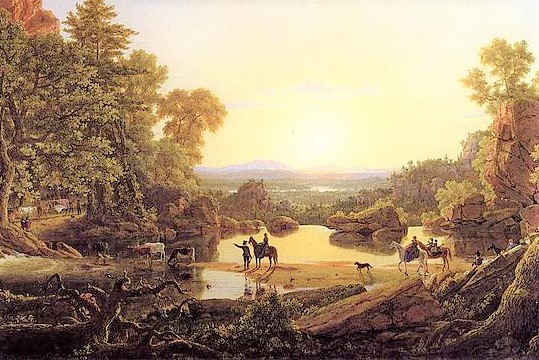
Hooker and Company Journeying Through the Wilderness From Plymouth
to Hartford in 1636 by Frederic Edwin Church, 1846
After Puritan pastor Rev. Thomas Hooker and others founded the colony of Connecticut, Hooker delivered an influential sermon before the Connecticut General Court in 1638 in support of popular sovereignty (people’s rule). It was the first time in the colonies that an American explicitly asserted democratic ideas. Notably, Hooker defended democracy based on the Bible.
In his sermon, Hooker advocated for certain Bible-inspired principles of self-government including popular sovereignty, consent of the governed, chosen representatives, limited government, and constitutions. Hooker supported these democratic principles based on Deuteronomy 1:13 in which Moses instructs the Israelites to “‘choose wise, understanding, and knowledgeable men from among your tribes, and I will make them heads over you.’” His sermon influenced the writing of Connecticut’s constitution, the Fundamental Orders of Connecticut of 1639, the first constitution in the American colonies.
Hooker later wrote a Survey of the Summe of Church Discipline in 1648 to explain the principles of Puritan Congregational Church doctrine and organization. Since the Puritans applied their form of church government to their civil government, this writing further reveals the Bible-based thought behind the Puritans’ governing principles.
Hooker is often described as “the father of American democracy” for his support of self-governing principles in the early American colonies.
From AHEF and Angela E. Kamrath.
—–
Source: Kamrath, Angela E. The Miracle of America: The Influence of the Bible on the Founding History and Principles of the United States of America for a People of Every Belief. Second Edition. Houston, TX: American Heritage Education Foundation, 2014, 2015.
Related articles/videos:
1. An Introduction to Popular Sovereignty
2. Who were the Pilgrims? Why did they come to America?
3. Why the Pilgrims Identified with the Ancient Israelites
4. The Mayflower Compact: The Pilgrims’ First Self-Governing Act in America
5. The Pilgrims’ Mayflower Compact as Covenant
6. The History of Thanksgiving Day in America
7. The Pilgrims & Private Property: What the Pilgrims Might Have Thought About Communism & Socialism
8. Three P’s That Led to Freedom in the West: Printing Press, Protestant Reformation, & Pilgrims
9. A City on a Hill: Why John Winthrop and the Puritans Came to America
10. The Puritans in America Identified with the Ancient Israelites and Practiced Covenants
11. Puritan Thomas Hooker: The Father of American Democracy
12. Why the Puritans Favored Limited Government
13. The Puritans in America Favored Rule of Law
14. The Puritans Elected Representatives to Govern in their American Colonies
15. Challenges in the Early Puritan Colonies: The Dilemma of Religious Laws & Religious Dissent
Activity: Miracle of America High School Teacher Course Guide, Unit 3, Part 2 of 3, Activity 4: The Political Ideas of Winthrop and Hooker, p. 118, 320. MS-HS.
The Political Ideas of Winthrop and Hooker
Purpose/Objective: Students learn about political ideas of Puritan leaders John Winthrop and Thomas Hooker, including their views on forms of government (Winthrop’s mixed government vs. Hooker’s democracy), mutual support for covenants and civil representatives, and Hooker’s initial support for and initiation of limited government, popular sovereignty, consent of the governed, and constitutions.
Suggested Reading: Chapter 3 of Miracle of America sourcebook/text. Students read sections from 3.1, 3.4, 3.6-3.11.
Think-Pair-Share and Venn Diagram. Students brainstorm with a partner and write down the similarities and differences between the political ideas of John Winthrop and Thomas Hooker. Discuss. See last week’s blog post for a link to download the “Venn Diagram” in the “Supporting Resources” section of this course guide, p. 320.
To download the whole unit, sign up as an AHEF member (no cost) to access the member resources page on americanheritage.org.
Copyright © American Heritage Education Foundation. All rights reserved.