Early Americans Valued a Strong, Bible-Inspired Work Ethic

Jamestown Garden by Sidney E. King, 1957
America is a country that was built upon hard work. The first settlers in what would become the original thirteen colonies of the United States were instrumental in creating a culture of work that would characterize our future nation. Much of their inspiration for work came from the Bible.
Captain John Smith’s Influence in Virginia

Engraving of Captain John Smith, 1616
In the first of the thirteen colonies of the United States, Virginia in the early 1600s, colony leader Captain John Smith had encouraged a strong, Bible-inspired work ethic among settlers because hardship, idleness, and greed had plagued many of those first colonists. Many settlers did not want to work or lacked proper skills and experience to survive in the harsh environment. Many spent their time searching for gold rather than farming. Such challenges threatened the colony’s success and existence.
As a result, Smith implemented a Christian work ethic based on 2 Thessalonians 3:10, in which the Apostle Paul says to believers, “If anyone will not work, neither shall he eat.” Smith likewise announced to the settlers, “You must obey this now for a law, that he who will not work shall not eat (except if by sickness he is disabled), for the labors of thirty or forty honest and industrious men shall not be consumed to maintain one hundred and fifty idle loiterers.” Smith’s Christian view of work was shared by the Puritans who arrived in America a few years later.
The Puritans’ Strong Work Ethic

John Cotton by John Smibert, 1850s
In their colonies of Massachusetts and Connecticut, the Puritans similarly valued and practiced hard work, industry, and diligence. Work was a central part of Puritan life and society and aligned with the Puritans’ Christian beliefs. The Puritans believed in living life as a service and glory to God.
In a sermon citing 1 Timothy 1 and 1 Corinthian 7, Puritan pastor John Cotton addressed God’s calling for man to work: “Faith draws the heart of a Christian to live in some warrantable calling. … Paul makes it a matter of thankfulness to God to have given him ability and put him in a place where he might serve God (1 Timothy 1:12). As God has called every man, so let each man walk (1 Corinthians 7:19-20). This is the clean work of faith, that a man would have some employment to fill his head and hand with.”
Work was a duty and responsibility, the Puritans saw, that allowed for mankind’s provision and prosperity. It could benefit the individual, family, society, and God as well as keep man away from the temptations of idleness and sloth. It could also fulfill God’s assignments and purposes. The Puritans did, in fact, prosper economically in America. Some thought this prosperity was due to continued worship and service of Christ.
The Opportunities in America for Hard Workers
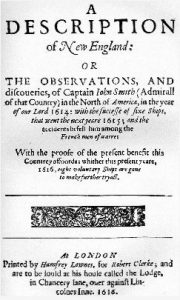
Title Page of A Description of New England by Captain John Smith, 1616
The American colonies attracted many from Europe because they gave people who were willing to work the opportunity to create better, fulfilling lives for themselves and their families. In his 1616 Description of New England, Captain Smith writes of the opportunity in America: “Here every man may be a master of his own labor and land. If he has nothing but his hands, he may set up his trade and by industry quickly grow rich.” Smith expressed the joy of working in a free environment for oneself and one’s posterity, with social mobility.
He elaborates, “If one has but a taste of virtue and magnanimity, what to such a mind can be more pleasant than planting and building a foundation for his posterity, got from the rude earth by God’s blessing and his own industry, without prejudice to any.” The opportunities in America for those who would work caused the American colonies to grow.
Influence on Future American Society
Though the pursuit of wealth later became more important than the pursuit of godliness for some, the church and the Bible continued to play an important role in American society. The Puritan work ethic influenced ideas of industry and capitalism and became an important part of American life in the future United States.
Conclusion
The early settlers of America, particularly those led by Captain John Smith and the Puritans, shaped the future of the United States through their strong, Bible-inspired work ethic. Their belief that hard work was a divine calling influenced the growth of the colonies and laid the foundation for American prosperity. The Bible’s emphasis on work and diligence remains a cornerstone in the nation’s history and culture, reflecting the enduring values that continue to shape American society today.
Get Involved and Learn More from AHEF
The values of hard work, diligence, and a faith-driven life continue to inspire Americans today. If you are passionate about learning more about the history of our nation and the biblical principles that influenced its founding, consider exploring AHEF’s educational resources that provide insights into America’s rich heritage. By understanding the roots of our nation’s work ethic, we can continue to build a society grounded in purpose and prosperity.
Visit our site or join our community to stay informed and inspired!
Contributed by AHEF and Angela E. Kamrath.
—–
Related Posts:
1. Three P’s That Led to Freedom in the West: Protestant Reformation, Printing Press, & Pilgrims
2. Who Were the Pilgrims? Why Did They Come to America?
3. Why the Pilgrims Identified with the Ancient Israelites
4. The Pilgrims’ Mayflower Compact as a Covenant
5. The Mayflower Compact: The Pilgrims’ First Self-Governing Act in America
6. The Pilgrims and Private Property: What the Pilgrims Might Have Thought About Communism and Socialism
7. The Pilgrims Persevered in Adversity
8. The First Thanksgiving in America
9. The History of Thanksgiving Day in America
10. The Puritans’ Moral Authority Was the Bible
11. A City on a Hill: Why John Winthrop and the Puritans Came to America
12. The Puritans in America Identified with the Ancient Israelites and Practiced Covenants
13. Why and How Did Schools Begin in the United States: The Puritans Supported Education for Bible Literacy
14. Bible Education and the Northwest Ordinance of 1787
Activity: Miracle of America High School Teacher Course Guide, Unit 3, Part 2 of 3, Activity 7: Economic Success in the Puritan Colonies, p. 119, 345. MS-HS.
Economic Success in the Puritan Colonies
Purpose/Objective: Students learn about the Puritans’ beliefs and values such as limited government, popular sovereignty, representative democracy, rule of law, literacy, and a strong work ethic as well as the colonies’ geographic region/climate, which contributed to the Puritans’ prosperity and economic success.
Suggested Reading: Chapter 3 of Miracle of America sourcebook/text. Students read sections Introduction to 3.13.
Economic Success Chart: Students consider question: What factors contributed to the economic success of the Pilgrim and Puritan colonies? Each student, working in pairs, completes the “Economic Success in the Puritan Colonies” chart. Students consider the Puritans’ Bible-inspired beliefs, values, and practices–including a strong work ethic–which influenced the economic success of the Puritan colonies. Have them also research and consider the geography and climate of the region/colonies and how it might have affected their industry, trade, and economic success. See the “Economic Success in the Puritan Colonies” chart in the “Supporting Resources” section of the course guide, p. 345.
To download this whole unit, sign up as an AHEF member (no cost) to access the “resources” page on americanheritage.org. To order the printed binder format of the course guide with all the units, go to the AHEF bookstore.
Copyright © American Heritage Education Foundation. All rights reserved.