Why and How Schools Began in the United States: The Puritans Supported Education for Bible Literacy
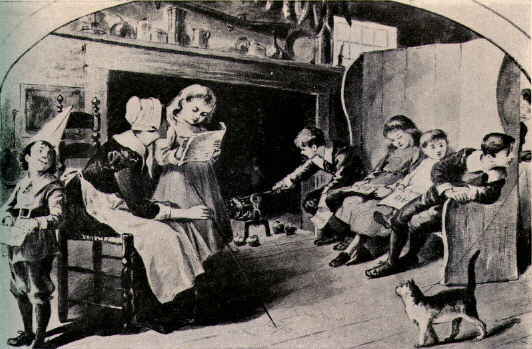
A New England Dame School in Old Colonial Times, 1713. Engraving. Bettman Archive.
Why and how did schools begin in the United States? The Puritans in colonial America strongly supported education. Literacy and education, they believed, were necessary firstly so that people could read and understand the Bible.
The Origins of Education in the United States
The Puritans felt so strongly about Bible literacy that they passed education laws requiring sizeable towns to set up schools and teach reading and writing. The Old Deluder Satan Act of 1647, for example, required communities and towns to set up and fund grammar schools and to hire schoolmasters. This act intended to prevent Satan, the “Old Deluder,” from deceiving people with illiteracy and keeping them from reading the Bible. The Puritans’ Old Deluder law became the basis for the public school system in America.
Influences from the Protestant Reformation
The Puritans’ support for Bible education and the Old Deluder law were influenced by the Protestant Reformation and their views about the church and the Bible. The Puritans held the view that all believers in Christ, not just church leaders like pope and clergy, may read and interpret the Bible.
This view stemmed from two Reformation concepts of reformer Martin Luther—“the priesthood of all believers” and sola scriptura. Sola scriptura, Latin for “scripture alone,” is the belief that the Bible—as the inspired, infallible Word of God—is the highest, final source of authority on Christian faith, doctrine, and practice. The Bible is the speaking and teaching, the authority of God. This idea is found in 2 Timothy 3:16: “All Scripture is given by inspiration of God and is profitable for doctrine, reproof, correction, instruction in righteousness.” Therefore, all earthly religious authorities and interpretations of scripture are subject to correction by the Holy Scriptures.
Since all believers are priests and ministers of God, and since the Bible is the final authority on Christian doctrine, the Puritans believed that all believers should read and know the Bible. They had an awareness that if the people do not read and know the Bible, they could be led astray by false teachings, heresies, and corruptions as had occurred in the late medieval Roman Catholic church in Europe prior to the Reformation.
The Role of the Bible in Early American Schools
American schools thus began with the Puritans in the 1600s to ensure Bible literacy. As expected, the Bible was the core of learning in schools. The New England Primer, the first reader in America, included Bible truths, stories, poems, hymns, and prayers. The Puritans founded many of the first colleges and universities in America—including Harvard, Yale, and Dartmouth—and they did so with a strong Christian purpose.
For example, Harvard’s rules and precepts declared, “Let every student be plainly instructed and earnestly pressed to consider well that the main end of his life and studies is to know God and Jesus Christ which is eternal life, John 17:3, and therefore to lay Christ in the bottom as the only foundation of all knowledge and learning.” These and future schools shaped the leaders and thinkers of early America, including the Founding Fathers of the United States.
Puritan Education’s Lasting Influence on American Society
The Puritans’ emphasis on education influenced the American public school system, widespread literacy, and the idea of an informed citizenry in America. This emphasis on literacy and education promoted strong religious convictions among colonists and led to the creation of the most literate, educated society in the world.
Continue Exploring the Impact of Puritan Education
Curious to learn more about how Puritan values shaped early America? Dive deeper into the history of education and its lasting influence on our society. AHEF has plenty of resources to fuel your curiosity. Explore our educational materials and join us in uncovering the stories that shaped the foundation of the United States!
Visit our blog or contact AHEF today to learn more.
From AHEF and Angela E. Kamrath.
—–
Related Posts:
1. Three P’s That Led to Freedom in the West: Protestant Reformation, Printing Press, & Pilgrims
2. The Context of the Protestant Reformation
3. The Igniting of the Protestant Reformation – Martin Luther’s 95 Theses
4. The Key Tenets of the Protestant Reformation
5. The Reformation Led to the Translation and Printing of the Bible Into the Peoples’ Common Languages
6. The Pilgrims Persevered in Adversity
7. Early Americans Valued a Strong Work Ethic
8. The Puritans’ Moral Authority Was the Bible
9. A City on a Hill: Why John Winthrop and the Puritans Came to America
10. The Puritans in America Identified with the Ancient Israelites and Practiced Covenants
11. Why the Puritans Favored Limited Government
12. The Puritans in America Favored Rule of Law Based on the Bible
13. The Puritans in America Created the First Written Constitution of Law
14. The Puritans in America Elected Representatives to Govern in their Colonies
15. Why Puritan Thomas Hooker Favored Democracy Over Aristocracy
16. Challenges in the Early Puritan Colonies: The Dilemma of Religious Laws and Dissent
17. Bible Education and the Northwest Ordinance of 1787
Activity: Miracle of America High School Teacher Course Guide, Unit 3, Part 2 of 3, Activity 5: Predicting What the Puritans’ New Colony Might Be Like, p. 119, 344. MS-HS.
Predicting What the Puritans’ New Colony Might Be Like
Purpose/Objective: Students learn about the Puritans’ Bible-based governing principles and values that characterized their colonies including moral truth, self-government, limited government, rule of law, constitutions, popular sovereignty, elected representatives, work ethic, and a literate citizenry.
Suggested Reading: Chapter 3 of Miracle of America sourcebook/text. Students read sections Introduction to 3:13.
Prediction Chart: (continued from Part 1 of this unit). After Part 2 and Part 3 lessons are taught, students fill out the third column on their prediction chart answering the questions of what happened in the colonies. How did the Puritans in fact set up their colonies? What were their governing principles and values? Have students compare the outcome with their prediction. Did they come close to predicting what happened? See the “Predicting What the Puritans’ New Colony Might Be Like” prediction chart in the “Supporting Resources” section of the course guide, p. 344.
To download this whole unit, sign up as an AHEF member (no cost) to access the “resources” page on americanheritage.org. To order the printed binder format of the course guide with all the units, go to the AHEF bookstore.
Copyright © American Heritage Education Foundation. All rights reserved.