The Two Kingdoms Doctrine: Religious Reformers Recognize the Civil and Spiritual Kingdoms
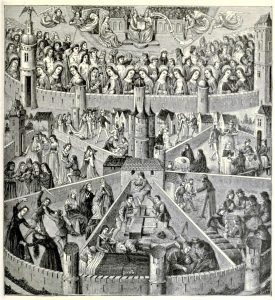
in a translation of St. Augustine’s The City of God.
Before and during the 1500s in Europe, countries were ruled by church states, and men had little religious freedom. Religious tolerance did not widely exist. The church and the civil state were combined and worked together to rule over the people and to regulate people’s religious beliefs and practices. People were forced to conform to the official state church of their country and monarch or else suffer persecution and punishments.
The idea of freedom of conscience—freedom of belief and conviction—was advanced by the Protestant Reformation of the 1500s and existed in Europe in the 1500s and 1600s. During the Reformation, reformers Martin Luther and John Calvin called for religious reform in the church but, in doing so, touched on political matters. They broached ideas of freedom of conscience, and thus tolerance, and greater distinction between church and civil state.
Religious Reformers Recognize the Civil and Spiritual Kingdoms
In the spirit of Augustine of Hippo who wrote about two cities, earthly and heavenly, in his The City of God (c426); Luther and Calvin recognized two kingdoms by which God rules—civil and spiritual—that concern the life of man. The civil kingdom is the earthly, temporal realm of man and concerns man’s physical life and relationship to others. Man under God has some authority in this kingdom. The spiritual kingdom is the heavenly, eternal realm and concerns man’s beliefs and relationship with God. God alone has authority in this kingdom. To the reformers, these two kingdoms have distinct jurisdictions.
In his 1520 Appeal to the Ruling Class of German Nationality as to the Amelioration of the State of Christendom and 1523 Secular Authority: To What Extent It Should Be Obeyed, Luther of Germany says that in the earthly realm, men’s external behavior should be regulated by civil laws and the universal moral Law of Nature. In the spiritual realm, men should be regulated by God and His deeper moral law that discerns the inner condition of men’s souls—men’s hearts, minds, and beliefs. To support this point, Luther draws on Matthew 22:21 in the New Testament in which Jesus tells the Pharisees, “‘Render to Caesar the things that are Caesar’s, and to God the things that are God’s.'” As such, Luther believed men should be able to freely choose their religious beliefs. The state, he thought, has no authority to force beliefs on men. He thus opposed physical punishments and tortures to coerce men in their beliefs.
Calvin, a Frenchman exiled in Geneva, Switzerland, shared many of Luther’s views of reform and the two kingdoms. In his 1536 Institutes of the Christian Religion, he writes, “Government is two-fold: the one spiritual, by which the conscience is trained in piety and divine worship; the other civil, by which the individual is instructed in the duties that men and citizens are bound to perform.” Calvin agreed that the state may regulate temporal matters but that only God has authority over eternal matters like religious belief.
To be sure, freedom of conscience was not embraced by everyone and was very restricted in actual practice in Europe at this time, manifesting in only partial, contested, temporary ways. Yet the Bible-based ideas of Luther and Calvin in favor of freedom of belief were asserted by later European and American political thinkers who impacted American thought and settlement in the 1600s and 1700s.
Contributed by AHEF, Dr. John Tyler, and Angela E. Kamrath.
—–
Related articles/videos:
1. An Introduction to Popular Sovereignty
2. Challenges in the Early Puritan Colonies: The Dilemma of Religious Laws & Religious Dissent
3. The First Experiments in Freedom of Belief and Religious Tolerance in America
4. Roger Williams and His Quest for Religious Purity
5. Roger Williams: First Call for Separation of Church and State in America
6. William Penn and His “Holy Experiment” in Religious Tolerance
7. Early Americans supported Religious Tolerance based on God as Judge of Conscience
8. Early Americans opposed Religious Persecution as contrary to the Biblical Teachings of Christ.
9. Early Americans argued Religious Coercion opposes Order of Nature
10. Early Americans Believed Religious Coercion Opposes Reason
11. Early Americans Supported Religious Tolerance within Civil Peace and Order
12. Philosopher John Locke and His Letters Concerning Toleration
13. The Religious Landscape of the Thirteen Colonies in Early America

Activity 1: Miracle of America High School Teacher Course Guide, Unit 1, Part 1, Activity 4: Details, Questions, and Conclusions (DQC), p. 56. HS. This unit is available to download from the Member Resources at www.americanheritage.org.
Activity 2: Miracle of America High School Teacher Course Guide, Unit 4, Part 2 of 2, Activity 3: History and Current Events: Religious Regulation and Persecution, p. 161. MS-HS.
History and Current Events: Religious Regulation and Persecution
Students identify and evaluate religious regulation as practiced in many countries historically and today. Students consider various state systems that regulate religion and/or religiously restrictive. Students learn about the religious oppression that often results from state regulation of religion.
Suggested Reading: Chapter 4 of Miracle of America sourcebook/text. Students read sections from Introduction to 4.2, 4.6-4.9, 4.13-4.22, and p. 124.
Activity 2: Article clippings and Class Discussion. 1) Have students read/research selected sections in Miracle of America sourcebook and other assigned readings (on religious oppression historically and in other countries today), think about and discuss examples in which state governments have regulated religion historically and in many countries today. Students may revisit the struggles that the early Puritans faced in trying to regulate religion in their colonies, a typical practice of that time. Ask students to provide modern-day examples of countries in which the government regulates religion in some way and explain. What happens in such situations? Have students think about and discuss the religious oppression and persecution that often results from state involvement in religion. 2) As an assignment, have students research world news and current events and collect one or more (world) news articles (online or in print) related to religious regulation/oppression/persecution. Students cut out or print articles and share them with the class. 3) Have students think about/reflect on living in such an environment and what it might be like. What might they think, feel, do?
To download this whole unit, sign up as an AHEF member (no cost) to access the “resources” page on americanheritage.org. To order the printed binder format of the course guide with all the units, go to the AHEF bookstore.
Copyright © American Heritage Education Foundation. All rights reserved.